
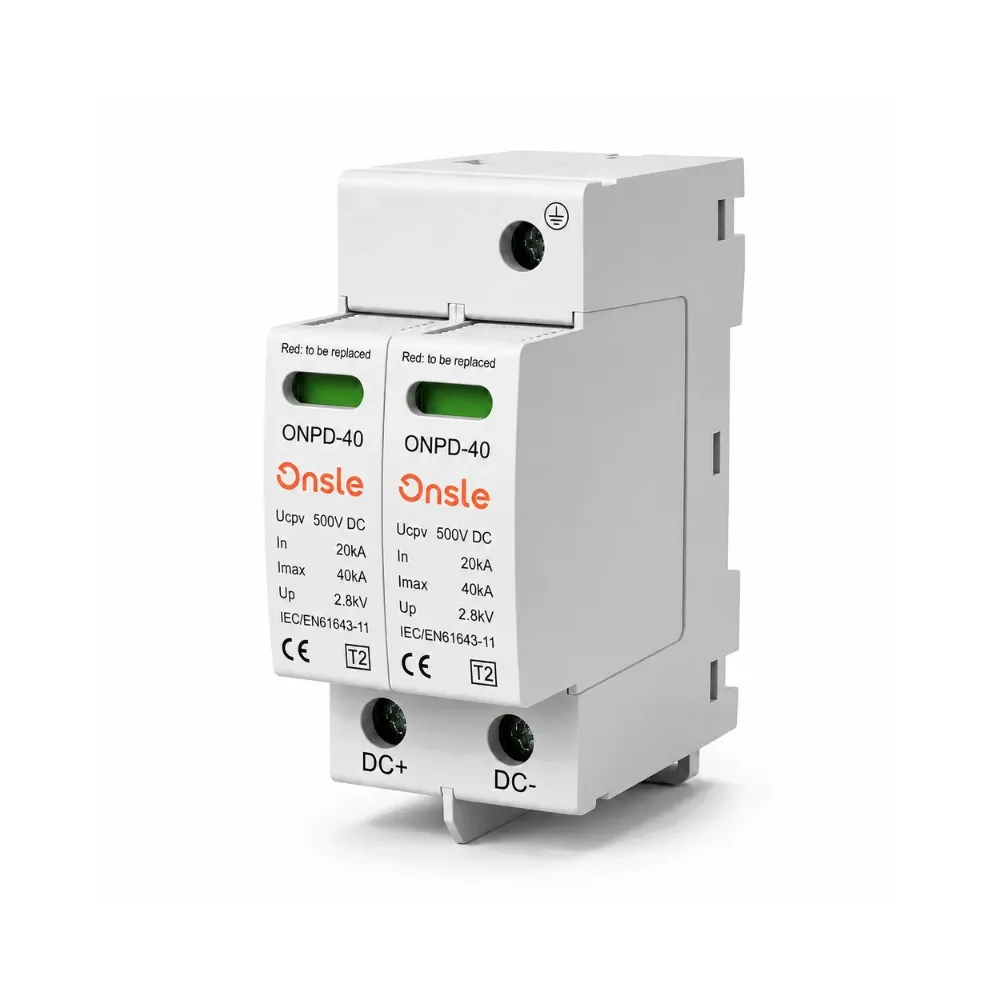
Lightning-induced surges travel much further in DC than in AC systems, and PV arrays are effectively large antennas on rooftops. Understanding what Type 1, Type 2 and combined devices actually do keeps you from over- or under-protecting a project.
Why PV arrays need surge protection
A direct or nearby lightning strike injects a high-energy impulse into the array, the mounting structure or the AC side. Without SPDs, that impulse finds the weakest insulation — usually inverter front-ends and optimizer electronics.
What the type classifications mean
Type 1: diverts direct lightning current
Tested with a 10/350 microsecond wave, Type 1 devices handle the energy of a direct strike. They belong at the origin of the installation where the down-conductor bonding exists.
Type 2: clamps residual surges
Tested with an 8/20 microsecond wave, Type 2 devices limit switching and induced surges to a level the equipment can survive. Most string and combiner-box protection is Type 2.
Type 1+2: combined devices
Combined units cover both test classes in one enclosure — common on PV where space in the combiner is limited and the risk profile justifies both waves.
Parameters worth comparing
| Parameter | What it tells you |
|---|---|
| Uc | Maximum continuous operating voltage — must exceed worst-case string voltage |
| Up | Voltage protection level — must stay below the equipment impulse withstand |
| In (8/20) | Nominal discharge current, Type 2 sizing |
| Iimp (10/350) | Lightning impulse current, Type 1 sizing |
DC SPDs are not AC SPDs
A varistor stack rated for 1,000 V AC behaves very differently on a 1,000 V DC string: there is no zero-crossing, so the SPD never fully stops conducting. Always use devices designed and tested for the DC application.
Monitoring and end-of-life
SPD degradation is silent. Remote-contact versions let a monitoring system see a failed cartridge instead of discovering it at the next site visit — specify them on unattended arrays.